
PA/NP Collaboration Guidelines
(Last revised 5/2025)
- The ED Physician collaborative patient evaluation guidelines outlined below are at the discretion of the ED physician.
- The NP/PA may request the ED physician to collaboratively evaluate any patient at any time during the patient’s ED course.
- The NP/PA is to time and document ED physician collaboration as specified below.
Basic Guidelines
Section titled “Basic Guidelines”-
Suspicious history and/or exam not consistent with radiology interpretation (concern for radiology discrepancy)
-
Unplanned patient returns to ED within 72 hours
-
ESI Level 1 (red)
-
Notify Medical Director of respective campus of any unanticipated patient death in the ED
- Involve ED physician as early and often as possible in anticipated ICU admissions and ill or concerning patient presentations
Admission Guidelines
Section titled “Admission Guidelines”-
All admissions to specialist services – discuss with ED Physician prior to call
-
Includes anyone except Sound, Family Practice, Med 1, Ortho, Surgery, OB/GYN, Urology.
-
Psychiatric admissions excluded from collaboration if vitals normal.
-
A physician must document a note on all patients admitted to an ICU.
Adult Guidelines (> 18 yo)
Section titled “Adult Guidelines (> 18 yo)”-
Abdominal pain > 60 yo that the NP/PA plans to discharge home
-
Unexplained, persistent abnormal vital signs including tachycardia
-
Syncope > 40 yo that the NP/PA plans to discharge home
Cardiopulmonary Guidelines
Section titled “Cardiopulmonary Guidelines”-
Non-specific and atraumatic chest pain > 40 yo that the NP/PA plans to discharge home
-
Pulmonary embolism that the NP/PA plans to discharge home
-
Patients with a suspected or confirmed arterial injury or occlusion
Neurologic Guidelines
Section titled “Neurologic Guidelines”-
CVAs/TIAs within 24 hours of symptoms. If stroke alert activated, the patient needs to be seen with ED physician.
-
New focal and/or neurological deficit
-
Intractable headache
-
Acute spinal fracture
-
Acute skull fracture
OB Guidelines
Section titled “OB Guidelines”-
Ectopic pregnancy
-
Precipitous delivery
-
ALL patients greater than 20 weeks gestation (discuss immediately with physician)
Ortho Guidelines
Section titled “Ortho Guidelines”-
Open fractures except open finger/toe tuft fractures
-
Fracture with skin tenting
-
Felon
-
Tenosynovitis
-
Muscle laceration
-
Tendon laceration
-
ED physician to interpret all plain film radiology not interpreted by a radiologist (e.g. overnights)
Pediatric Guidelines (< 18 yo)
Section titled “Pediatric Guidelines (< 18 yo)”-
Fever < 60 days old (ED physician is to be made aware of these patients immediately)
-
Pediatric complaints < 3 months of age
-
Syncope < 18 yo that the NP/PA plans to discharge home
Psych Guidelines
Section titled “Psych Guidelines”-
Suicidal or homicidal ideation that the NP/PA/LCSW plan to discharge. If telepsychiatry recommendation is to discharge home, can dismiss without collaboration with ED physician.
-
Significant impairment from drugs or alcohol
-
Patients with unexplained vital sign abnormalities
-
HR > 110 or Systolic B/P < 90
Specialist Guidelines
Section titled “Specialist Guidelines”NP/PA may call after discussion with ED physician
Section titled “NP/PA may call after discussion with ED physician”-
Neurosurgery
-
Oral Surgery
-
Plastic surgery
-
Ophthalmology
-
Trauma (If APP is not ATLS certified, patient needs to be seen by ED physician.)
-
Vascular
-
Cardiothoracic Surgery
-
Anesthesiology
- Emergent specialist intervention required in the ED - discuss with ED physician.
Procedures
Section titled “Procedures”NP/PA Procedures WITH Collaboration of ED Physician:
Section titled “NP/PA Procedures WITH Collaboration of ED Physician:”- Lumbar Puncture
- Thoracentesis
- Central Venous Access
- Needle Decompression/Tube Thoracostomy
- Emergent Pericardiocentesis
- Endotracheal Intubation
- Neuromuscular Blockade
- Mechanical Ventilation
- Cardioversion/Defibrillation/CPR
- Cardiac Pacing - External/Transthoracic
- Gastric Lavage
- Moderate Sedation
- Deep Sedation
NP/PA Procedures WITHOUT Collaboration of ED Physician:
Section titled “NP/PA Procedures WITHOUT Collaboration of ED Physician:”- Local Anesthesia
- Incision and Drainage of Cutaneous Abscesses
- Wound Management and Repair
- Local Anesthesia
- Incision and Drainage of Cutaneous Abscesses
- Wound Management and Repair
- Nasogastric/Orogastric Tube Insertion
- Epistaxis Control
- Arterial Sampling of Blood Gas Analysis
- Fracture/Dislocation Immobilization
- Closed Reduction of Fracture or Dislocation
- Nursemaid’s Elbow Reduction
- Nail Trephination
- Joint Injection/Arthrocentesis
- Splint Placement
- Removal of Splints/Casts
- IV Placement
- Slit/Wood’s Lamp Exam with or without Foreign Body Removal
- Tonometry
- Bladder Catheterization
- Replacement of Suprapubic Catheters and PEG Tubes
- Digital Nerve Blocks
- Foreign Body Removal
- Mild Procedural Sedation Including Nitrous Oxide (with approval)
- Perform ECG
- Cervical Immobilization/Clearing of C-Spine Immobilization
- Ultrasound for ED Procedures/ED Emergencies
- Contrast Injection for Imaging
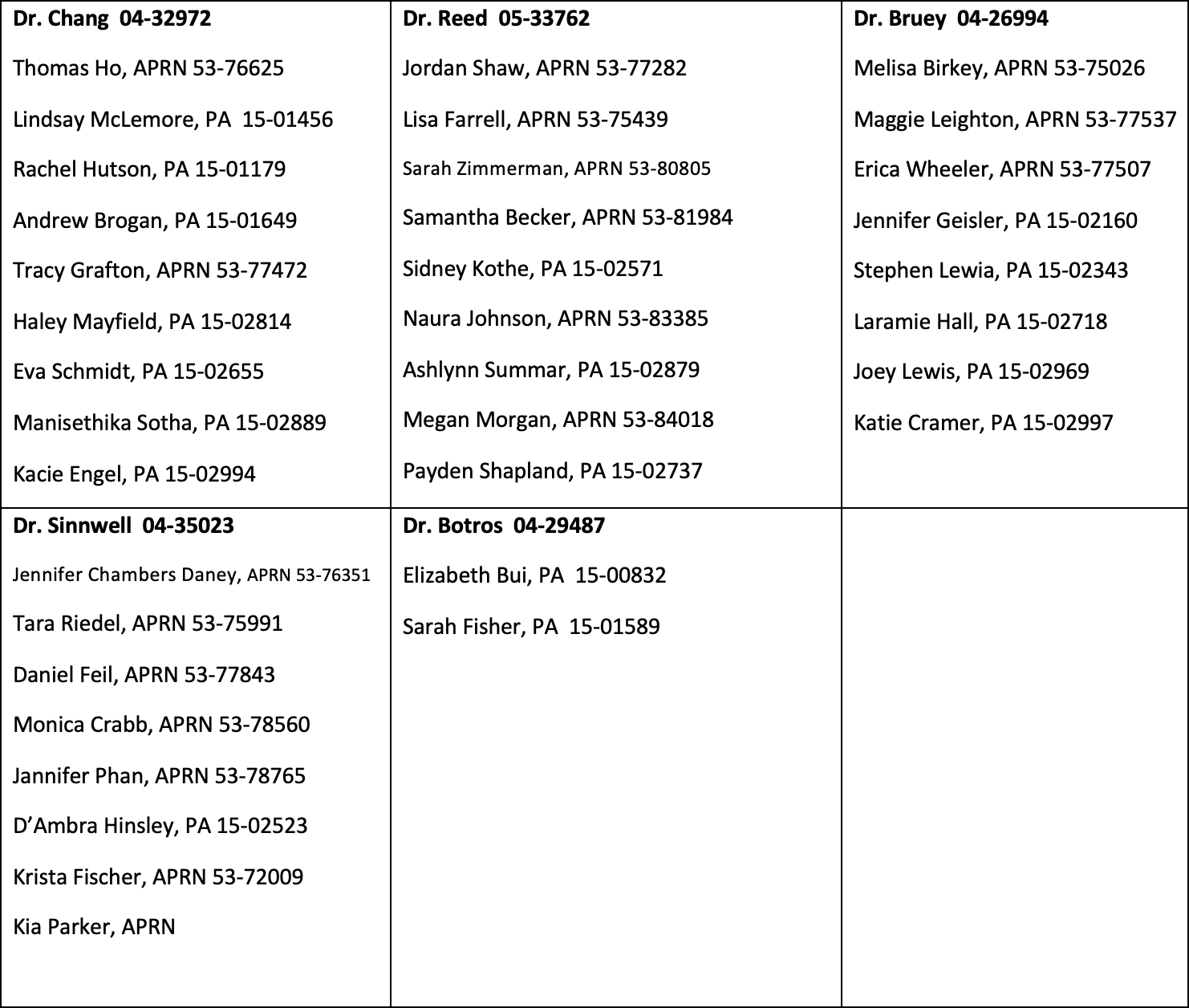
Supervising Physician List
Section titled “Supervising Physician List”